
“Stops rust” sounds simple.
In practice, it can mean several different things.
A product may:
- remove corrosion products;
- chemically convert part of a rust layer;
- isolate steel from water, oxygen and electrolytes;
- inhibit corrosion reactions;
- penetrate a rusty surface and leave a protective film;
- reduce the rate of future corrosion.
Those are not the same result.
And none of them restores steel that has already been consumed by corrosion.
That distinction matters on a vehicle.
A frame with light surface rust, a heavily scaled suspension bracket and a panel with deep pitting may all look “rusty,” but they do not present the same treatment problem.
The useful question is therefore not simply:
“Can this product stop rust?”
It is:
“What is the product actually doing to the rusted surface, and what evidence shows that it reduces further corrosion under the conditions that matter?”
Editorial disclosure: Underbody Lab did not conduct the tests discussed in this article. This guide separates general corrosion-control principles, published research and manufacturer claims so readers can understand what different rust treatments can — and cannot — do to already-rusted steel.
At a glance
| Treatment approach | What it can do | What it cannot do |
|---|---|---|
| Mechanical rust removal | Removes loose rust, scale and deteriorated material | Replace metal already lost |
| Chemical rust remover | Dissolves or removes corrosion products when used as directed | Restore original thickness |
| Rust converter | Reacts with some corrosion products to form a different surface layer | Guarantee all rust is neutralized or future corrosion cannot recur |
| Oil/lanolin/wax protectant | Can form a barrier and, depending on formulation, penetrate or displace moisture | Remove existing section loss |
| Paint or hard protective coating | Can isolate properly prepared steel from the environment | Make unstable scale into sound steel |
| Repeated maintenance treatment | Can renew protection as films wear or wash away | Turn a badly weakened component back into a structurally sound one |
The important line is the last one:
Corrosion control can protect remaining metal. It cannot recreate missing metal.
Rust is a corrosion product, not something that is “alive”
Rust does not spread because it is a living organism.
Steel corrosion is an electrochemical process.
AMPP describes corrosion as deterioration of a material through chemical or electrochemical reaction with its environment.
For ordinary automotive steel, continued corrosion depends on the local environment and electrochemical conditions.
Moisture, oxygen, dissolved salts, coating condition, geometry and contamination can all matter.
That means corrosion can be slowed or interrupted if the conditions supporting it are changed.
A protective coating may isolate the metal from the environment.
An inhibitor may interfere with corrosion reactions.
A fluid protectant may form a moisture-resistant barrier.
A converter may react with corrosion products and create a different layer.
But these mechanisms should not be collapsed into the vague phrase “kills rust.”
What does “stop existing rust” actually mean?
There are at least four different claims hidden inside that phrase.
1. Remove the rust
This means corrosion products are physically or chemically removed.
The surface may then be prepared for another protective system.
2. Convert the rust
A rust converter reacts with some components of a rusty surface to form different compounds or a conversion layer.
The rust has not been “erased.”
The surface chemistry has been changed.
3. Suppress further corrosion
A protective layer reduces contact between the remaining steel and the environment or otherwise inhibits the corrosion process.
The old corrosion products may still be present.
4. Repair the damage
This would mean restoring lost section thickness.
Ordinary rust treatments do not do this.
Once steel has been converted into corrosion products and material has been lost, a rustproofing product cannot rebuild the original steel section.
Why lost metal matters
Article #12, Surface Rust vs. Pitting: Why They’re Not the Same Problem, explains why visible appearance and penetration depth are different variables.
A rusty surface may have:
- light broad attack;
- loose scale;
- localized pits;
- thinning;
- perforation.
A protectant may reduce further attack while leaving all of that previous damage physically present.
So a treatment can be successful at corrosion control while doing nothing to restore structural capacity already lost.
That is why deep pitting, perforation or corrosion on a safety-critical part should not be judged solely by whether a new coating makes the surface look better.
Protective coatings work by changing exposure
AMPP describes protective coatings as an effective way to protect metal from corrosion by isolating the substrate from its environment.
A barrier coating can protect steel by limiting contact with:
- water;
- oxygen;
- electrolytes.
Other coating systems can also use inhibitive or sacrificial mechanisms.
The central idea is that the remaining metal is protected by changing the conditions at the metal/environment interface.
This is why a sound coating system can reduce future corrosion.
But AMPP also treats surface preparation as part of the coating process.
The coating is not independent of the condition of the surface underneath it.
Surface preparation still matters
Applying a product over rust does not mean every rusty surface is ready for coating.
Loose rust and scale can be mechanically weak.
Old coatings can be poorly adhered.
Salt, oil, mud and other contamination can remain on the surface.
If a coating bonds to loose material instead of a stable substrate, the weak layer underneath can become the failure point.
AMPP’s corrosion terminology defines power-tool cleaning as removal of loose rust, loose mill scale and loose coating by methods such as wire brushing, sanding and grinding.
AMPP’s protective-coating guidance also emphasizes surface preparation as part of a corrosion-protection system.
That does not mean every product requires abrasive blasting to bare steel.
Different products specify different preparation.
It does mean:
“Can be applied over rust” should never be translated into “surface condition does not matter.”
Even products designed for rust usually require preparation
Manufacturer instructions make this point clearly.
Rust-Oleum’s Rust Reformer technical data says the product is intended for rusted steel where only limited preparation is practical.
But it still instructs users to:
- remove dirt, grease, oil, salt and chemical contaminants;
- rinse;
- allow the surface to dry;
- scrape and wire-brush loose rust, scale and deteriorated coating.
So even a product specifically marketed as a rust converter does not treat unstable scale, salt contamination and dirty steel as irrelevant.
That distinction is important.
Applying over remaining rust is not the same as applying over loose, contaminated rust without preparation.
Rust converters change the surface rather than removing all rust
Rust converters are often based on chemistries that react with iron corrosion products.
Tannic-acid and phosphoric-acid systems are widely discussed in published research.
In these systems, reactions can produce compounds such as iron tannates or iron phosphates and alter the rust layer.
That can create a surface intended to be more suitable for subsequent coating.
But the performance of rust converters is not universal.
It depends on the formulation and the condition of the rusted surface.
Published research shows why “converted” does not automatically mean “protected”
A 2004 study in Corrosion Science evaluated a rust converter based on tannic and phosphoric acids on rusted steel with different corrosion levels and salt contamination.
The researchers confirmed conversion of corrosion products, including formation of iron phosphates and tannates.
But the coating-performance results were more complicated.
For painted specimens with lower contamination, the researchers did not find a significant difference that justified improved paint performance from the converter.
For heavily chloride-contaminated rusted specimens, the converter was harmful in the test conditions.
That does not prove that rust converters are ineffective.
It shows why the statement:
“The rust turned black, therefore the corrosion problem is solved”
is too strong.
A chemical conversion reaction and long-term coating performance are different questions.
Salt contamination can remain a problem
This is especially relevant to vehicles exposed to deicing salts.
A rusted surface may contain chloride contamination in:
- pores;
- pits;
- seams;
- scale;
- surface deposits.
Article #8, Why Cars Rust Faster in the Snow Belt, explains why chlorides and moisture matter in winter corrosion.
The 2004 rust-converter study also shows that contamination level can influence converter performance.
And Rust-Oleum’s own Rust Reformer instructions specifically call for removal of salt and chemical contaminants before application.
So a black converted surface should not automatically be assumed to be contaminant-free.
A converter does not rebuild pits
Suppose a rusty frame has a 1 mm-deep pit.
A converter may react with corrosion products in or around that pit.
A subsequent coating may reduce future exposure.
But the cavity still exists.
The original metal thickness has not returned.
This is why converter performance and structural condition are separate questions.
The same principle applies to:
- rust removers;
- oils;
- waxes;
- paints;
- undercoatings.
They may protect what remains.
They do not replace what is gone.
What about oil, lanolin and wax-type protectants?
Soft or non-drying rust protectants work differently from hard paint-like coatings.
Depending on formulation, manufacturers describe them as:
- penetrating;
- moisture-displacing;
- creeping into seams;
- leaving an oily, waxy or gel-like barrier.
These properties can be useful where a hard coating is difficult to apply or where access into seams and cavities matters.
But product claims need to be labeled correctly.
Fluid Film
Fluid Film’s manufacturer FAQ says the product is not formulated to remove rust.
The manufacturer claims that when applied over existing rust it penetrates rust and scale to the base metal and stops further spreading.
Its automotive material also describes the product as a non-drying lanolin-based barrier that penetrates and creeps.
Those are manufacturer claims, not independent proof that every rusty automotive surface will stop corroding indefinitely after one application.
B’laster Surface Shield
B’laster likewise says Surface Shield does not remove rust.
The manufacturer says it creates a moisture barrier and that applying it over rust can help prevent further corrosion.
Again, that is useful product information.
It should not be turned into the stronger statement:
“Lanolin permanently stops existing rust.”
Product durability, coverage, washing, abrasion, existing contamination and surface condition still matter.
Manufacturer claims can disagree in emphasis
This is another reason Underbody Lab should avoid broad category claims.
Fluid Film says its product can be applied over existing rust and claims penetration through rust scale.
B’laster says Surface Shield can be applied over rust but separately tells users that it does not remove rust.
Rust-Oleum’s converter is specifically designed to react with rust but still requires removal of loose scale and contamination.
Woolwax’s current Hard-On product page and linked application instructions say the coating is not intended for surfaces with any existing surface rust and direct rusted frames to Original Woolwax. However, Woolwax’s current sell sheet says Hard-On can be applied to slightly rusted surfaces but is not intended for surfaces with significant surface rust. Because the manufacturer’s own current materials conflict, users should follow the instructions supplied with the product they purchase.
These examples show that “rust protection” is not one technology.
The instructions for the actual product matter.
Soft protectants and hard coatings solve different problems
A soft protectant can remain mobile or non-drying.
That may help it:
- creep;
- re-wet exposed surfaces;
- enter seams;
- tolerate some movement.
A hard coating may provide a more rigid barrier and better resistance to some forms of mechanical contact.
But hard films also depend heavily on adhesion.
A hard coating applied over unstable scale can fail with the material underneath it.
A soft coating may tolerate a rough rusty surface differently but may require maintenance if it is displaced or washed away.
Neither category should be declared universally superior.
Article #4, Oil-Based vs. Rubberized Undercoating: How They Differ, explains some of these category differences.
Can you simply coat over rust?
Sometimes — but the answer depends on what kind of rust and what product.
Article #1, Can You Spray Undercoating Over Rust? What to Do Before You Coat, covers the practical preparation question in more detail.
A reasonable evidence-based framework is:
Light, tightly attached surface rust
Some rust converters and some soft corrosion-preventive products are specifically designed or marketed for application over remaining rust after the required cleaning and preparation.
Follow the product’s actual instructions.
Loose or flaky scale
Remove unstable material first.
A coating over loose scale is only as stable as the material it is attached to.
Heavy salt or dirt contamination
Clean the surface according to the product specification.
Do not assume a converter or protectant neutralizes contamination simply because it covers it.
Deep pitting or major section loss
Corrosion protection may reduce further deterioration, but the existing loss remains.
The part may need separate condition assessment.
Perforation or severely weakened structural metal
This is no longer just a coating-selection question.
A protective product cannot restore missing structural steel.
Rust remover and rust converter are not interchangeable
Article #2, Rust Converter vs. Rust Remover: What’s the Difference?, covers this distinction in detail.
The short version is:
A rust remover aims to remove corrosion products.
A rust converter aims to react with them and leave a converted layer.
Those approaches create different surfaces and different preparation requirements.
Neither should be described as magically reversing corrosion.
Can rust continue underneath a coating?
Yes, if the conditions allow it.
A coating may fail to provide complete protection because of:
- pinholes or holidays;
- poor adhesion;
- damaged areas;
- uncoated edges;
- seams;
- contamination;
- retained moisture;
- coating breakdown.
Article #13, Why Seams, Crevices and Trapped Moisture Rust Differently, explains why hidden joints and sheltered locations can behave differently from open surfaces.
So seeing a coated surface does not prove the underlying steel is corrosion-free.
The effectiveness of the system depends on coverage, adhesion, environment and maintenance.
“Sealing rust in” is too simple
People often describe undercoating as either:
“sealing rust away from oxygen”
or:
“trapping moisture and making rust worse.”
Both statements can be too simplistic.
A properly functioning barrier coating can reduce exposure to water, oxygen and electrolytes.
A poorly prepared or damaged coating system can leave pathways for corrosion.
The real question is whether the coating system:
- adhered to a stable surface;
- covered the intended area;
- excluded or inhibited the corrosive environment;
- stayed intact in service.
That is more useful than arguing over whether coatings inherently “seal” or “trap” rust.
What does “stopped” look like in a real test?
This is harder than it sounds.
If a manufacturer says a product “stops rust,” a meaningful test should define what that means.
Possible measurements include:
- no increase in rusted area;
- lower mass loss than an untreated control;
- lower maximum pit depth;
- reduced electrochemical corrosion rate;
- less scribe creep;
- less coating failure;
- better performance across repeated specimens.
Article #10, How Rust Protection Products Are Actually Tested, explains why the measurement must match the failure mode.
A photo showing that rust turned black is evidence of appearance change.
It is not by itself proof that long-term corrosion has stopped.
Why untreated controls matter
Suppose a coated rusty panel develops a little more rust after six months.
Did the product fail?
Not necessarily.
The stronger question is:
How did it perform compared with the same rusty steel left untreated under the same exposure?
If the untreated specimen loses far more metal, the product may still have provided meaningful corrosion control.
Conversely, if a coated panel looks good in a mild environment where the untreated control also barely corrodes, the test proves little.
This is why controls matter.
“Stops rust instantly” should be read as a product claim
Some manufacturers use strong phrases such as:
- “stops existing rust”;
- “prevents future rust”;
- “converts rust to a non-rusting surface.”
Underbody Lab should reproduce those claims only as manufacturer claims and then ask:
- What test supports it?
- What surface preparation was used?
- Was the substrate already rusted?
- Was chloride contamination present?
- How long was the exposure?
- Was there an untreated control?
- Was failure measured by appearance, mass loss, pitting or something else?
- Was the work independently published?
Marketing language and engineering evidence are not the same category of information.
What should you do before treating existing rust?
A practical sequence is:
- Inspect the condition.
Determine whether the issue is light surface rust, loose scale, deep pitting, perforation or corrosion in a safety-critical location. - Clean contamination.
Remove mud, grease and salt using methods compatible with the component and chosen product. - Remove unstable material.
Scrape, wire-brush, sand or otherwise remove loose rust and failing coating as required by the product system. - Choose the treatment for the actual goal.
Are you removing rust, converting it, coating it, penetrating seams or maintaining an existing protective film? - Follow the manufacturer’s preparation and application requirements.
“Rust treatment” is not a universal application specification. - Inspect again later.
Protection is a maintenance system, not proof that the substrate can never corrode again.
Article #3, How to Prepare a Rusty Truck Frame for Undercoating, goes deeper into the preparation sequence.
When protection is not enough
Rustproofing should not be used to hide uncertainty about structural condition.
Additional assessment may be warranted when corrosion involves:
- deep localized pitting;
- perforation;
- major flaking or delamination;
- visibly thinned structural members;
- brake, suspension or steering attachment areas;
- severe corrosion around mounting points.
A corrosion-control product may still be useful after the part is judged serviceable or repaired.
But the product itself cannot make that engineering decision.
What Underbody Lab will mean by “stops rust”
Underbody Lab should use that phrase carefully.
Unless a specific test supports a stronger claim, a better description is:
“reduces or suppresses further corrosion under the tested or specified conditions.”
For product pages, the site should distinguish:
- manufacturer says: product stops or prevents rust;
- published evidence shows: measured reduction under stated test conditions;
- Underbody Lab testing shows: only after original testing exists.
That keeps a marketing phrase from becoming an unsupported universal conclusion.
Bottom line
Rust protection can reduce or interrupt further corrosion.
But different products do that in different ways.
A rust remover removes corrosion products.
A rust converter chemically changes part of the rust layer.
A soft oil, lanolin or wax protectant can form a protective barrier and may penetrate rusty or hidden surfaces depending on the formulation.
A hard coating can isolate properly prepared steel from the environment.
None of these rebuilds metal that corrosion has already removed.
And none should be assumed to work regardless of:
- rust severity;
- loose scale;
- chloride contamination;
- preparation;
- coating coverage;
- damage;
- service environment.
So when a product says it “stops rust,” ask one more question:
Stops what, by what mechanism, under what conditions, and measured how?
That is the difference between a marketing promise and a useful corrosion-control claim.
Learn more: Can You Spray Undercoating Over Rust? · Rust Converter vs. Rust Remover · How to Prepare a Rusty Truck Frame for Undercoating · Oil-Based vs. Rubberized Undercoating · Why Cars Rust Faster in the Snow Belt · How Rust Protection Products Are Actually Tested · Surface Rust vs. Pitting · Why Seams, Crevices and Trapped Moisture Rust Differently · Rust Prevention · Undercoating
Sources
- AMPP — Protective Coatings for Corrosion Control. Explains barrier, inhibitive and sacrificial coating mechanisms and identifies surface preparation as part of a protective-coating system.
- AMPP — What Is Corrosion? Defines corrosion as deterioration resulting from chemical or electrochemical reaction with the environment and provides general corrosion-control context.
- AMPP — Corrosion Terminology: P. Defines power-tool cleaning as removal of loose rust, loose mill scale and loose coating by methods including wire brushing, sanding and grinding.
- L.M. Ocampo, I.C.P. Margarit, O.R. Mattos, S.I. Córdoba-de-Torresi, F.L. Fragata — “Performance of rust converter based in phosphoric and tannic acids,” Corrosion Science 46 (2004), 1515–1525. Published study of a tannic/phosphoric-acid rust converter on steel with different corrosion and salt-contamination levels. The converter changed rust chemistry, while coating-performance effects depended on contamination and test condition; high chloride contamination produced adverse results.
- Rust-Oleum — 3575 System Rust Reformer Technical Data. Manufacturer documentation describing the product as a rust-conversion coating and requiring removal of oil, grease, salt, chemical contaminants, loose rust, scale and deteriorated coatings before application. Manufacturer source, not independent performance evidence.
- Fluid Film — Frequently Asked Questions. Manufacturer states that Fluid Film is not formulated to remove rust and claims that application over existing rust can penetrate the rust layer and stop further spreading. Manufacturer claim, not independent proof of universal automotive performance.
- Fluid Film — Automotive Applications / Fluid Film Black Technical Information. Manufacturer describes the product as a lanolin-based, non-drying corrosion-preventive film that creeps and penetrates seams and is marketed for vehicle undercoating. Manufacturer source.
- B’laster — Surface Shield FAQs. Manufacturer states that Surface Shield does not remove rust, forms a moisture barrier and can be applied over rust to help prevent further corrosion. Manufacturer source.
- Woolwax — Hard-On Permanent Rust Coating for Trucks & Equipment. The current product page and linked application instructions say Hard-On is not intended for surfaces with any existing surface rust, while Woolwax’s sell sheet says it can be applied to slightly rusted surfaces but excludes significant surface rust. Manufacturer documentation is therefore inconsistent on this point.
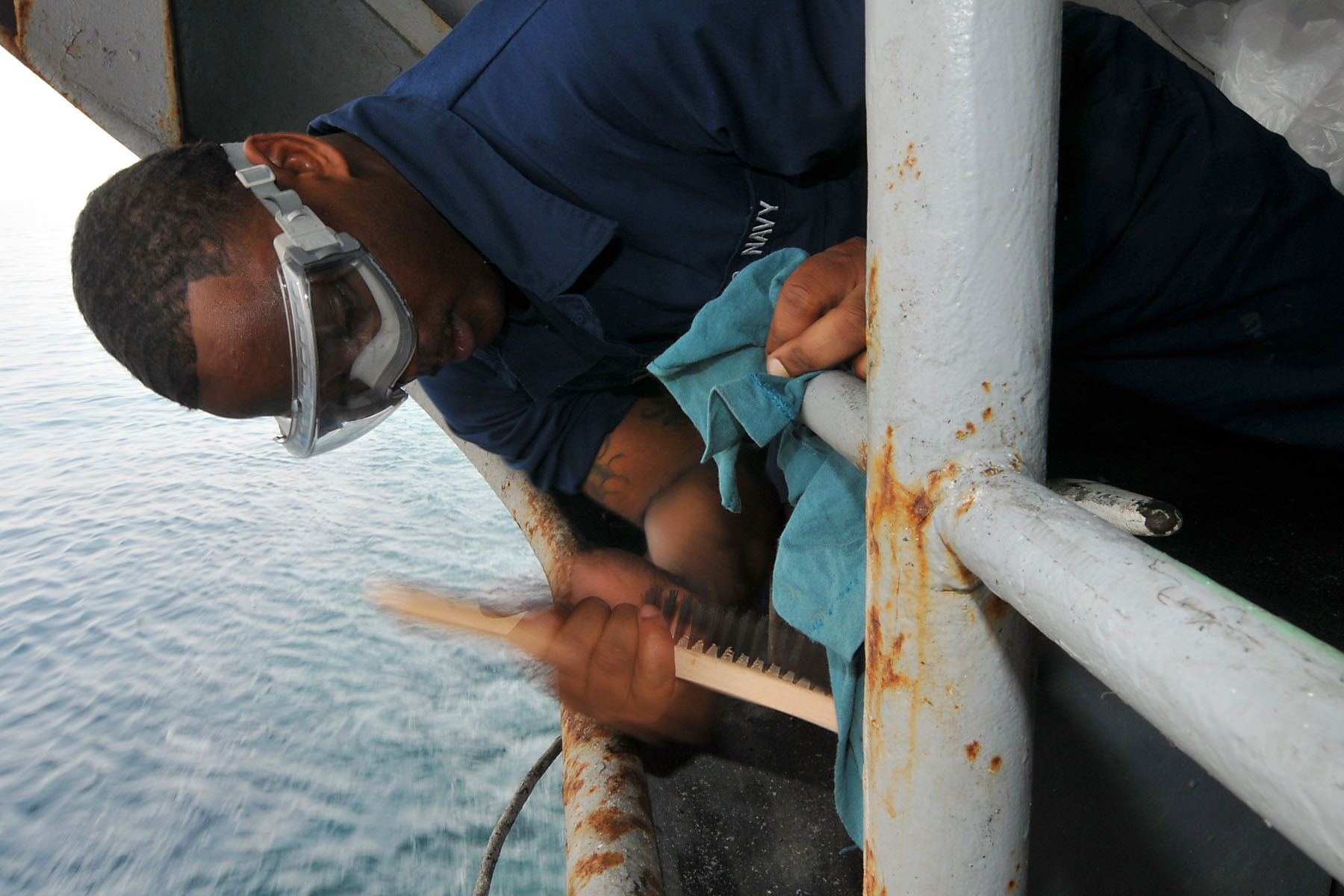
Featured image: U.S. Navy photo 110512-N-1004S-248 (May 12, 2011; Mass Communication Specialist 3rd Class Shawn J. Stewart), via Wikimedia Commons. Public domain in the United States as a work of the U.S. federal government; use does not imply U.S. Navy endorsement. Cropped and displayed in grayscale. It shows a sailor wire-brushing rust from a shipboard deck fitting — not an Underbody Lab treatment or test.
