
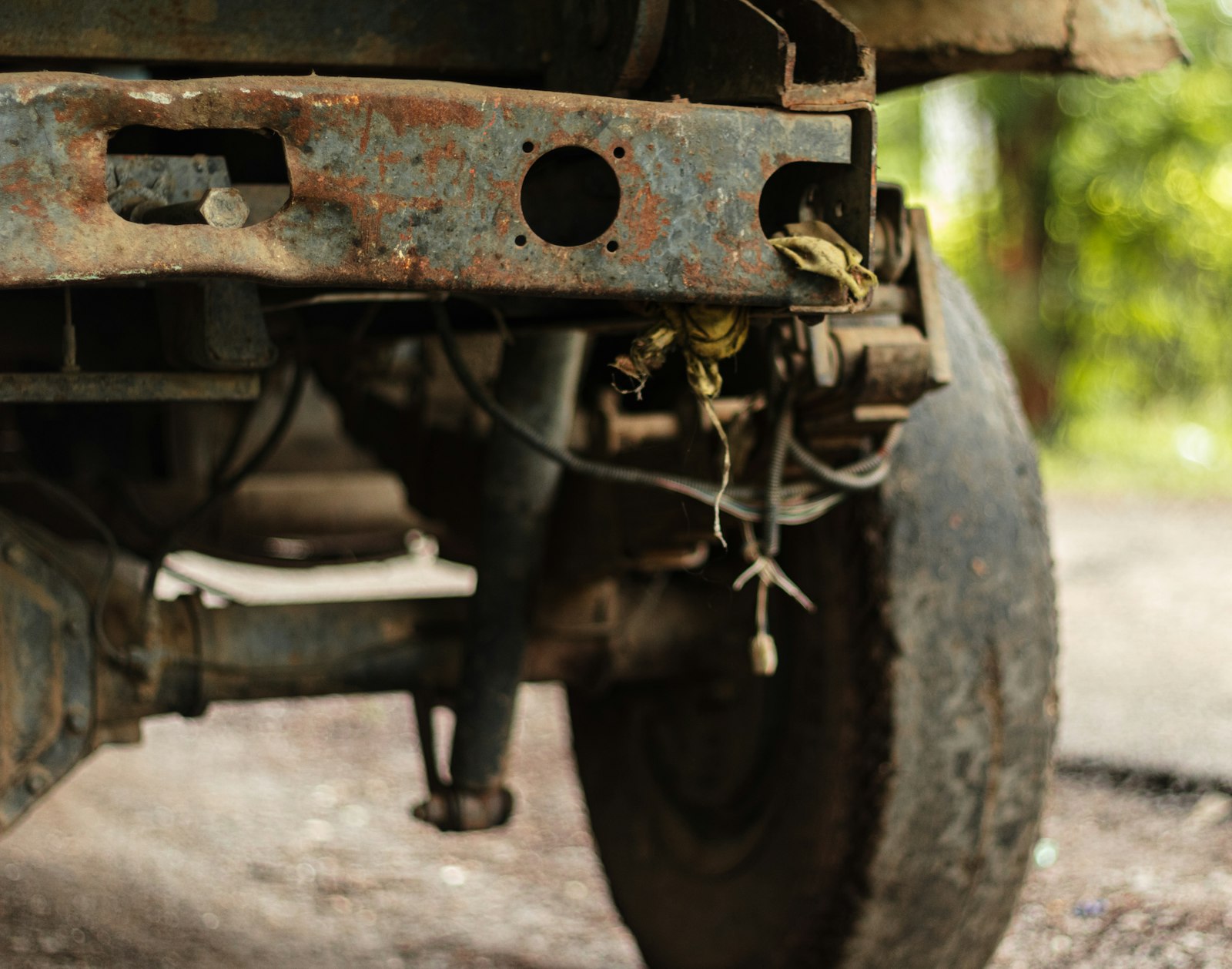
The short answer
Yes, some automotive undercoatings and corrosion-protection products can be applied over existing rust—but not all of them.
The right approach depends on two things:
- How severe the rust is
- What product you plan to apply
A non-drying corrosion inhibitor can have very different preparation requirements from a hard-curing or rubberized undercoating. Some manufacturers specifically allow their products to be applied over existing rust, while others require loose rust or rust scale to be removed first.
What you should not do is treat undercoating as a way to hide badly deteriorated metal. If a frame, mounting point, suspension area, or other important component has heavy scaling, perforation, or significant metal loss, applying a coating does not restore the strength of the steel.
First, determine how bad the rust is
Not all rust represents the same level of damage. Discoloration alone doesn’t tell you how serious corrosion is, so check the condition of the metal underneath.
Light surface rust
Surface rust affects the outside of the metal while the material underneath may still be solid. This is the type of corrosion most likely to be compatible with a rust-treatment or undercoating process after appropriate cleaning and preparation.
Scaling or flaking rust
Once corrosion starts producing loose flakes or scale, spraying over it creates a weak foundation. The material under a coating needs to be stable enough to support it.
Perforation or severe metal loss
If corrosion has eaten through the metal or substantially weakened it, the problem has moved beyond ordinary rust prevention. Undercoating is a protective treatment, not a structural repair. Areas involving frame integrity, suspension mounting points, body mounts, or other safety-related components may need repair or professional assessment before being covered.
Why surface preparation matters
A protective coating is only as secure as the surface beneath it. Rust isn’t the only concern. An underbody can also carry:
- Road salt
- Mud
- Oil and grease
- Old, loose coatings
- Sanding or grinding debris
- Moisture
Manufacturers routinely call for removing these first. Rust-Oleum’s instructions for its Automotive Rubberized Undercoating, for example, say surfaces must be free of dirt, dust, oil, grease and “any contamination that may interfere with adhesion,” and direct users to remove loose paint and rust with a wire brush or sandpaper.
That doesn’t mean every undercoating requires bare, shiny steel. It means you should prepare the surface according to the specific coating system you are using.
Can different types of undercoating go over rust?
This is where the answer becomes product-specific.
Non-drying lanolin-based coatings
Some non-drying corrosion inhibitors are marketed specifically for use over existing rust. Fluid Film, for example, says it is “not formulated to remove rust,” but states that it will penetrate rust and rust scale to the base metal and leave a wet, non-drying film.
That is a manufacturer claim, not an independent Underbody Lab test.
Original Woolwax is another lanolin-based product that, according to the manufacturer, does not dry and remains soft. Woolwax’s own product page for its Hard-On coating directs owners of rusted frames to Original Woolwax instead.
So a product in this category may not require the same surface condition as a hard-curing coating. That still doesn’t mean you should spray it blindly over mud, salt, loose scale, or severely deteriorated steel.
Hard-curing coatings
Hard coatings can have much stricter requirements. Woolwax describes its Hard-On coating as developed for new or reasonably new surfaces and says it is not intended for surfaces with surface rust. The same page recommends against using it on restored frames, noting that some surface rust usually can’t be removed.
That’s why “you can spray undercoating over rust” is too broad on its own: two coatings from the same manufacturer can have completely different surface requirements.
Rubberized undercoatings
Rubberized undercoatings should also be judged by the instructions for the specific product.
Rust-Oleum’s current Professional Undercoating technical data sheet includes preparation instructions for sound rust surfaces. Under the heading “Bare Metal or Sound Rust Surfaces,” it says to wash off dirt, grease, oil, salt and chemical contaminants, let the surface dry thoroughly, and remove loose paint and rust with a wire brush or 120–220 grit sandpaper.
Rust-Oleum’s Automotive Rubberized Undercoating similarly requires a contamination-free surface and directs users to remove loose paint and rust with a wire brush or sandpaper.
So it would be inaccurate to say rubberized undercoating can never go over rust—but equally misleading to suggest you can spray it directly over any rusty surface without preparation.
3M Undercoating
3M’s technical data sheet for Undercoating 08881 tells users to remove surface contaminants by abrading with a coarse-to-medium abrasive as needed and cleaning with a VOC-compliant surface cleaner. 3M’s product page says the aerosol offers good coverage on bare or primed metal.
The important point isn’t that one method is universally correct. It’s that the product’s technical instructions determine the acceptable preparation.
What about rust encapsulators such as POR-15?
A rust-encapsulating or rust-preventive coating isn’t necessarily the same product category as conventional undercoating. POR-15 Rust Preventive Coating is an example. Its technical data sheet says it is designed for application directly on rusted, sandblasted, and seasoned metal, and instructs users to remove grease, oil, and other foreign substances using POR-15’s own cleaner and prep products.
POR-15 also makes strong marketing claims, including that the coating will stop rust permanently. Underbody Lab treats those as manufacturer claims, not independently verified performance.
The useful takeaway is that some coating systems are designed around treating and sealing prepared rust, while other undercoatings mainly serve as a protective layer.
Do you need to remove all rust before undercoating?
Not necessarily. Whether every trace of rust needs to go depends on the product. Some systems are designed to go over stable existing corrosion. Others require:
- Bare metal
- Primed metal
- Very light rust only
- Removal of rust scale
- A particular rust treatment before coating
In conventional body repair, the usual approach is to remove the rust, prepare the surface, and then apply a primer and coating system. Underbody corrosion products vary much more, which is why the technical data sheet for the product you’re actually using should take priority over generic advice.
Should you use a rust converter before undercoating?
Not automatically. A common assumption is that every rusty frame should get rust converter followed by undercoating. That may suit some systems, but it isn’t a universal rule.
Before combining a rust converter and an undercoating, check:
- Whether the converter requires a topcoat
- Whether it needs to be rinsed or neutralized
- How long it must cure
- Whether the undercoating is compatible with it
- Whether the undercoating manufacturer recommends a primer instead
Mixing unrelated coating systems without checking compatibility can create its own adhesion problems. For how converters and removers differ, see Rust Converter vs. Rust Remover: What’s the Difference? and our Rust Converters page.
Basic preparation before undercoating a rusty surface
The exact process varies by product, but a sensible sequence is:
- Inspect the corrosion. Determine whether you’re dealing with surface rust, loose scale, or serious metal deterioration.
- Clean the area. Remove road grime, salt, oil and other contaminants using a method compatible with the coating you plan to use.
- Remove loose material. Brush, scrape, sand or otherwise remove loose rust and failing coating as the product requires.
- Clean away the debris. Don’t leave sanding dust or abrasive residue on the surface.
- Meet the product’s moisture requirements. Many coatings require a dry surface; follow the exact instructions.
- Use any required treatment or primer. Some products need one, others don’t.
- Apply the coating at the manufacturer’s specified thickness and conditions.
Leftover dust, rust particles, or grease can interfere with whatever goes on next, so clean prepared metal before coating it. For a step-by-step walkthrough on frames, see How to Prepare a Rusty Truck Frame for Undercoating.
When you should not simply undercoat the rust
Stop and investigate further if you find:
- Holes through the metal
- Severe flaking or delamination
- Substantial thinning
- Badly corroded body mounts
- Questionable suspension mounting areas
- Badly corroded frame sections
- Damage that may require welding or replacement
Covering severe corrosion can also make it harder to see how the area changes later. If there’s any question about a component’s structural condition, inspection should come before coating.
What areas should you avoid spraying?
Do not spray the underside indiscriminately. Check the coating manufacturer’s instructions and the vehicle’s service information for areas that must remain uncoated or be masked.
The product instructions reviewed for this guide include these specific restrictions:
- 3M Undercoating 08881: do not apply on or near exhaust components, sparks, or flame, or on moving parts (technical data sheet).
- Rust-Oleum Professional Undercoating: not for surfaces that come in direct contact with heat or high temperatures, such as mufflers and exhaust components (technical data sheet).
- Rust-Oleum Automotive Rubberized Undercoating: do not apply to surfaces that exceed 200°F (93°C) when heated, or to galvanized metal (technical data sheet).
- Fluid Film: use caution around rubber that isn’t oil-resistant, because it may cause swelling (FAQ).
Quick decision guide
| Situation | What to do |
|---|---|
| Light surface rust | A compatible coating may be suitable after proper cleaning and preparation. |
| Loose or flaky rust | Remove unstable material first. |
| Heavy scale or metal loss | Assess the condition of the metal before coating it. |
| Using a non-drying lanolin coating | Check the manufacturer’s instructions; some specifically allow application over existing rust. |
| Using a hard or rubberized coating | Pay close attention to surface-preparation requirements. |
| Using a rust converter first | Confirm compatibility with whatever goes on top. |
| Structural corrosion | Undercoating is not a repair. |
Frequently asked questions
Can I spray undercoating directly over surface rust?
Sometimes. Some manufacturers allow their coatings to be used over stable or lightly rusted surfaces after preparation. Others require cleaner, primed, or rust-free metal.
Do I have to grind a frame down to bare metal?
Not for every coating system. Follow the preparation requirements for the exact product you’re using.
Will undercoating stop existing rust?
Don’t treat that as a universal promise. Some manufacturers claim their products stop existing corrosion from spreading, but results depend on the coating, the preparation, exposure, and the condition of the metal.
Should I use a rust converter before undercoating?
Only when the converter and coating are compatible and the application instructions support that combination.
Can rubberized undercoating go over rust?
Some rubberized products allow application over properly prepared, sound rust, while others have stricter requirements. Rust-Oleum’s current Professional Undercoating technical data sheet, for example, includes preparation instructions for sound rust surfaces. Check the technical data sheet rather than assuming all rubberized coatings behave alike.
Can I undercoat a badly rusted frame?
A protective coating should not be used as a substitute for repairing structurally deteriorated steel. Significant scaling, perforation, or questionable mounting areas should be evaluated before being covered.
Bottom line
You can sometimes spray undercoating over rust, but the answer depends on the rust and the product.
Stable surface corrosion may be compatible with certain coatings after proper preparation. Loose scale, contamination, and deteriorated metal need more attention first.
Most importantly, don’t assume that Fluid Film, Woolwax, rubberized undercoating, POR-15, and other corrosion treatments all work the same way. They don’t. Inspect the rust, prepare the surface, and follow the technical instructions for the exact product you’re applying.
Learn more: Undercoating · Rust Removal · Rust Converters · Rust Prevention
Sources
This guide is based on manufacturer documentation. Underbody Lab has not tested the products mentioned.
- Fluid Film — Frequently Asked Questions
- Woolwax (woolwax.ca) — product information
- Hard-On by Woolwax — product page (woolwax.ca)
- Rust-Oleum Professional Undercoating — technical data sheet (Form GDH-661)
- Rust-Oleum Automotive Rubberized Undercoating — technical data sheet
- 3M Undercoating 08881 — technical data sheet (June 2020)
- 3M Undercoating — product page
- POR-15 Rust Preventive Coating — technical data sheet
- POR-15 Rust Preventive Coating — product page